




Dr. Tara Chand Gupta
M.D., D.M. Medical Oncology | Bhagwan Mahaveer Hospital & Research Center Expert in Chemotherapy, Targeted Therapy, and Immunotherapy
Targeted therapy for cancer in Jaipur
If you are looking for advanced cancer treatment, targeted therapy for cancer in Jaipur works on specific changes inside cancer cells instead of affecting the whole body. It is planned after proper testing, so the treatment suits your condition. Book your appointment today to consult a specialist.


Overview
Comprehensive Overview of Targeted Therapy
Targeted therapy is used when doctors find specific changes inside cancer cells that can be treated in a more focused way. It is not started for every patient. In targeted therapy for breast cancer, reports are first checked to see if those changes are present, because this treatment works only in such cases. The approach is not general; it is planned based on how the cancer is behaving and what is actually driving its growth. It may be used to control the disease, slow it down, or support other treatments depending on the condition.
- Special tests help identify gene changes or markers in cancer cells.
- Treatment is planned based on the mutation, not just the stage.
- It can help control or slow the growth of cancer.
- Follow-ups are done to check how the treatment is working.
When to Consult
When should you consult for target therapy?
Targeted therapy is not advised in every case, so it becomes important to know when it should actually be considered. In targeted therapy for cancer, doctors usually suggest consultation when reports need to be reviewed in detail to check if this treatment is suitable. Since this approach works only when specific changes are present, timely consultation helps in understanding whether it will actually benefit the patient or not.
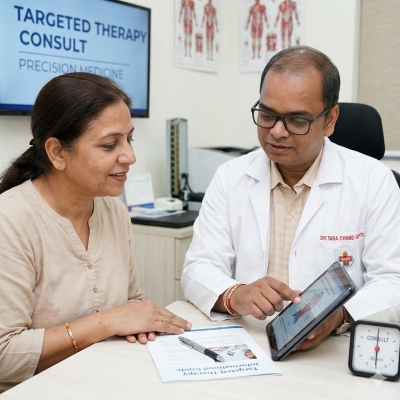

When reports suggest the presence of specific gene changes or markers

When the disease needs a more focused and specific treatment approach

When the current treatment is not giving the expected response

When you want to understand if targeted therapy is suitable in your case
Philosophy
Guiding Principles Behind Cancer Treatment
Cancer healing is not just about administering the right medicines but facilitating patients through a physically and emotionally demanding phase of life. Dr. Tara Chand Gupta, a cancer specialist in Jaipur, believes that targeted therapy must be approached thoughtfully, which means a thorough understanding of each patient’s condition. His focus is always on the selection of effective yet safe treatment at the right time for long-term patient care while maintaining safety and long-term patient well-being. The guiding principles he follows in his approach include:
- Treatment planning is personalized according to the state of the patient
- Only therapies are considered that are both evidence-based and medically appropriate
- Along with clinical outcomes, patient comfort is also prioritized.


Experience
About doctor
Meet Dr. Tarachand Gupta
M.D., D.M. – Medical Oncology
Specialist in Chemotherapy, Targeted Therapy, and Immunotherapy in Jaipur
Dr. Tara Chand Gupta is a medical oncologist in Jaipur who has been treating cancer patients for more than 12 years. He got his MBBS from SMS Medical College in Jaipur and his MD in General Medicine from SN Medical College in Agra. After that, he trained in Medical Oncology. He has treated people with breast, lung, kidney, gallbladder, bone, oral cancers, and many other cancers over the years using chemotherapy, targeted therapy, and immunotherapy. His focus is on selecting treatments that are effective while aiming for minimal side effects, ensuring patients across Rajasthan receive balanced and carefully monitored cancer care.
 More About Doctor

Advanced Therapies

Advanced Therapies

Advanced Therapies

Why choose
Why do patients trust Dr. Tara Chand Gupta for target therapy in Jaipur?
Dr. Tara Chand Gupta, who offers targeted therapy for breast cancer, states that there should be no haste with treatment and every patient needs to be understood first. He spends time reviewing reports, learning about the way in which the disease is behaving, and then develops a treatment plan that fits the patient’s situation. What sets him apart is:
- Only after a proper understanding of reports and the condition, treatment is started
- The plan is adjusted if the body is not responding as expected
- Patients are guided step by step so they are clear about the treatment
- Regular follow-ups help track progress and make timely changes
What is targeted therapy in cancer?
Targeted therapy is a more specialized type of cancer treatment compared to traditional treatments. It does not affect all fast-growing cells, but only targets some changes inside the cancer cell directly responsible for their growth. These alterations are often associated with genes or proteins that enable tumors to endure, thrive, and metastasize in the body.
This treatment works by blocking these signals/pathways, slowing cancer progression and, in some cases, stopping it altogether. This precision means it is often viewed as a more controlled form of treatment and is delivered as part of an organised approach to cancer care.
Before someone can start on targeted therapy for cancer in Jaipur, doctors first run special tests to see if these targets exist in the cancer. Not all patients qualify for it, so only after a proper evaluation is a decision made. After confirmation, further treatment is planned accordingly so that the patient’s condition can be matched and the disease can be controlled to a greater extent.
Understanding How Targeted Therapy Affects Cancer Cells
In targeted therapy for cancer in Jaipur, the treatment is tailored to target specific alterations inside cancer cells; these can be mutations in a gene or specific proteins that promote the cancer’s survival. Rather than affecting the entire body, it acts in a more targeted way by identifying what’s driving the disease in that person. It works like:
- Acts on certain mutations: Some cancer cells have mutations in their genetic material that cause them to grow more rapidly. This therapy aims to identify those changes and target them directly.
- Interrupts growth signals: Cancer cells are dependent on signals to continue dividing. The treatment helps to suppress these signals, slowing or stopping further growth.
- Disturbs how cancer survives: Cancer cells utilize certain pathways to stay alive. Targeted therapy interferes with these pathways, so the cells cannot function properly
- Limits tumor growth: Some treatments limit the development of new blood vessels that tumors require, controlling the growth.
- More focused effect: It has action only against specific changes, so it is less likely to affect normal cells, thereby yielding a more localized effect.
Because of this focused approach, doctors first understand the cancer profile and then plan the treatment in a way that actually fits the condition, which is why targeted therapy for lung cancer is used in selected cases where these changes are clearly identified.

Different Forms of Targeted Cancer Treatment
Targeted therapy is not just one type of treatment. It is used in different ways depending on what kind of change is present in the cancer. Doctors look at reports and then decide which type will actually work for that patient.
- Monoclonal antibodies: These are medicines made in a lab that attach to certain parts of cancer cells. Once attached, they block growth or help the body identify and remove those cells.
- Small molecule drugs: These go inside the cancer cell and affect the signals that help it grow, which slows down the disease and stops further spread.
- Angiogenesis inhibitors: These stop the tumor from making new blood vessels, which are needed for its growth, so the cancer does not get enough support to grow.
- Signal blockers: These treatments stop the internal signals that cancer cells use to grow and multiply, helping to control the disease.
- Cell death triggers: Some medicines help cancer cells die naturally by activating the body’s process of removing damaged cells.
The type is always chosen after understanding the condition, which is why targeted therapy is planned in a more specific way in targeted therapy for lung cancer.
Eligibility for Targeted Therapy Treatment
In targeted therapy for cancer in Jaipur, this treatment is only considered when reports show that the cancer has certain changes that can be specifically targeted. It is not based only on stage or symptoms, but mainly on what is seen in testing.
- When mutation is clearly present: If tests show a specific gene change or protein that is helping the cancer grow, then this treatment is useful because it directly acts on that change.
- In other cancer types, based on reports: It may also be used in blood cancers, skin cancers, thyroid cancers, lung cancers, breast cancers, or urinary cancers if suitable targets are found.
- When a specific drug option is available: This treatment is used only if there is a medicine that can act on that particular change found in the cancer.
- When doctors want a more focused approach: In some cases, instead of using a general treatment, this is chosen to act more precisely based on the cancer profile.
- When reports support its use clearly: The decision is always taken after reviewing biopsy and test results, not just based on symptoms or general condition.
Because this treatment depends completely on what is seen in testing, it is planned only after proper evaluation so that it actually gives results for that patient.
Stage and Condition-Based Use of Targeted Therapy
In targeted therapy for cancer in Jaipur, this treatment is not used in standard practice for cancer patients, but only when reports show that it can be done in a certain stage of the disease and in a focused way. The stages and conditions are:
- When cancer has spread: It is most frequently used for advanced stages of the disease, when cancer has metastasized to other areas of the body, and there needs to be a treatment that works systemically.
- When reports show a clear target: If tests confirm specific gene changes or proteins, this treatment is used because it can act directly on those changes present in cancer cells.
- In cancers like lung or breast: For instance, Targeted therapy in cancers such as lung or breast cancer, when reports say that the targeted treatment can be beneficial for this patient.
- When surgery is not an option: In certain scenarios where surgical removal of tumors cannot be performed because of their aggressiveness or extent, this treatment is administered to help control the disease.
- Along with other treatments: It could be administered along with other treatments, such as chemotherapy, depending on the disease response and how feasible that approach would be.
- When long-term control is needed: In some patients, it is taken to suppress the disease over a longer time and keep it in check, rather than treating the disease with a single step.
This is the reason that doctors carefully map out treatment, and tests are only utilized for options like targeted therapy for breast cancer when reports clearly indicate using this type of approach.
Diagnosis Before Targeted Therapy
Dr. Tara Chand Gupta, a cancer specialist in Jaipur, does not start targeted therapy for his patients straightaway. First, things are properly checked out because this treatment only works if certain changes are actually present in the cancer. The diagnosis starts with:
- Biopsy: A small sample is taken, so we can confirm what type of cancer we’re dealing with, because doctors need to know exactly what they’re dealing with before planning anything
- Gene or marker testing: The special test that is performed to check if the cancer has any specific changes, as without these targets, this treatment will not work.
- Detailed tumor testing: A closer examination of the cancer to determine what is driving its unchecked growth, so that doctors can choose an appropriate medicine.
- Blood tests and health check: The body is checked to determine whether the patient is fit enough for the treatment, without causing other major complications.
- Go through the reports: Since all the reports are seen together before action is taken, not initiated without proper clarity.
That is the reason each and everything is checked step by step with the aim that the treatment is utilized when it can truly do something worth retrieving, this is what applies for targeted therapy for cancer in Jaipur in a practical manner.
Understanding the Treatment Process
The cancer specialist in Jaipur takes a step-by-step approach after checking reports, so that it suits the patient and works in a controlled and manageable way. The procedure starts with:
- How the treatment is administered: It can be given in pill form that patients take regularly at home, or via drip during a hospital stay, depending on what medicine it is and how sick the patient is.
- Treatment schedule: Some medications are to be taken daily without long breaks, while some are supposed to be given after a certain number of days or weeks, so the body gets time to adjust and act properly.
- Length of treatment: There is no set length of time for treatment, and it can last months or more dependent on how the cancer is responding and how the patient is tolerating it.
- Treatment monitoring: Regular examinations are done by doctors to read blood reports and overall condition status to know whether the treatment is being conducted appropriately or if any changes need to be made during the process.
- Changes in treatment plan: If the response is not what was hoped for, or side effects emerge, doctors may change the dose or switch up the medicine so the treatment stays appropriate and manageable.
This is how the targeted therapy for cancer in Jaipur is planned elaborately so that it accommodates the patient’s condition and continues in a stable and controlled manner.
Side Effects of Targeted Therapy
With the use of targeted therapy for cancer in Jaipur, there can be side effect which is different from other treatments. So let’s see what the side effects are during targeted therapy:
- Skin changes: Patients might experience dryness, rash, sensitivity to light, or changes in hair growth while going through treatment.
- High blood pressure: Some of the medicines can raise blood pressure, so regular monitoring is important during treatment.
- Bleeding issues: In very rare instances, patients may experience easy bruising or bleeding as some drugs impact blood vessel formation.
- Blood clots: Some of these can elevate the risk for forming blood clots in the legs or lungs, requiring immediate medical attention.
- Slow healing of wounds: Some medications may slow down the healing of cuts or wounds as they influence the creation of new blood vessels.
- Heart-related: In rare cases, certain drugs can affect heart function, which is why your doctor checks on your heart health before and during treatment.
- Immune-related reactions: Infrequently, the immune system can respond abnormally and destroy normal body parts.
- Weakness and fatigue: As the body adjusts to the medicines, patients may feel low on energy during treatment.
- Nausea and vomiting: Some patients may experience nausea or vomiting, but these symptoms are generally controllable with medication.
- Digestive alterations: Problems such as diarrhoea or stomach pangs can occur during treatment.
- Headache: Some patients might suffer mild headaches during the treatment process, based on how the body responds
Hence, if you’re tense about these side effects, then don’t be because these are manageable, and the doctor is continually monitoring the patient so that treatment can be done safely and comfortably.
How Target Therapy is Planned and Managed by Dr. Tarachand Gupta
Cancer Specialist in Jaipur, Dr. Tara Chand Gupta, does not start treatment directly. First, he understands all reports properly, because this treatment works only when everything is clearly identified.
- Checking reports properly: He goes through biopsy and testing reports in detail to see if targeted therapy is actually suitable for that patient before starting anything.
- Planning step by step: Treatment is decided slowly, including which medicine to use and how to give it, so that the body can handle it without too much stress.
- Regular follow-ups: Patients are checked during treatment through tests and visits to understand if the treatment is working or if anything needs to be changed.
- Managing side effects early: If any problem arises during treatment, it is handled on time so that the patient stays stable and treatment continues smoothly.
- Making changes when needed: If the response is not proper, the plan is adjusted so that the treatment remains suitable for the patient’s condition.
- Clear patient guidance: Everything is explained thoroughly so patients know what to expect and feel more comfortable during the process.
This is how treatment is handled virtually so that it suits the patient and works better over time, especially when planning options like targeted therapy for cancer in Jaipur.
Contact Us
Reach Out for Expert Cancer Care


Patient Recovery
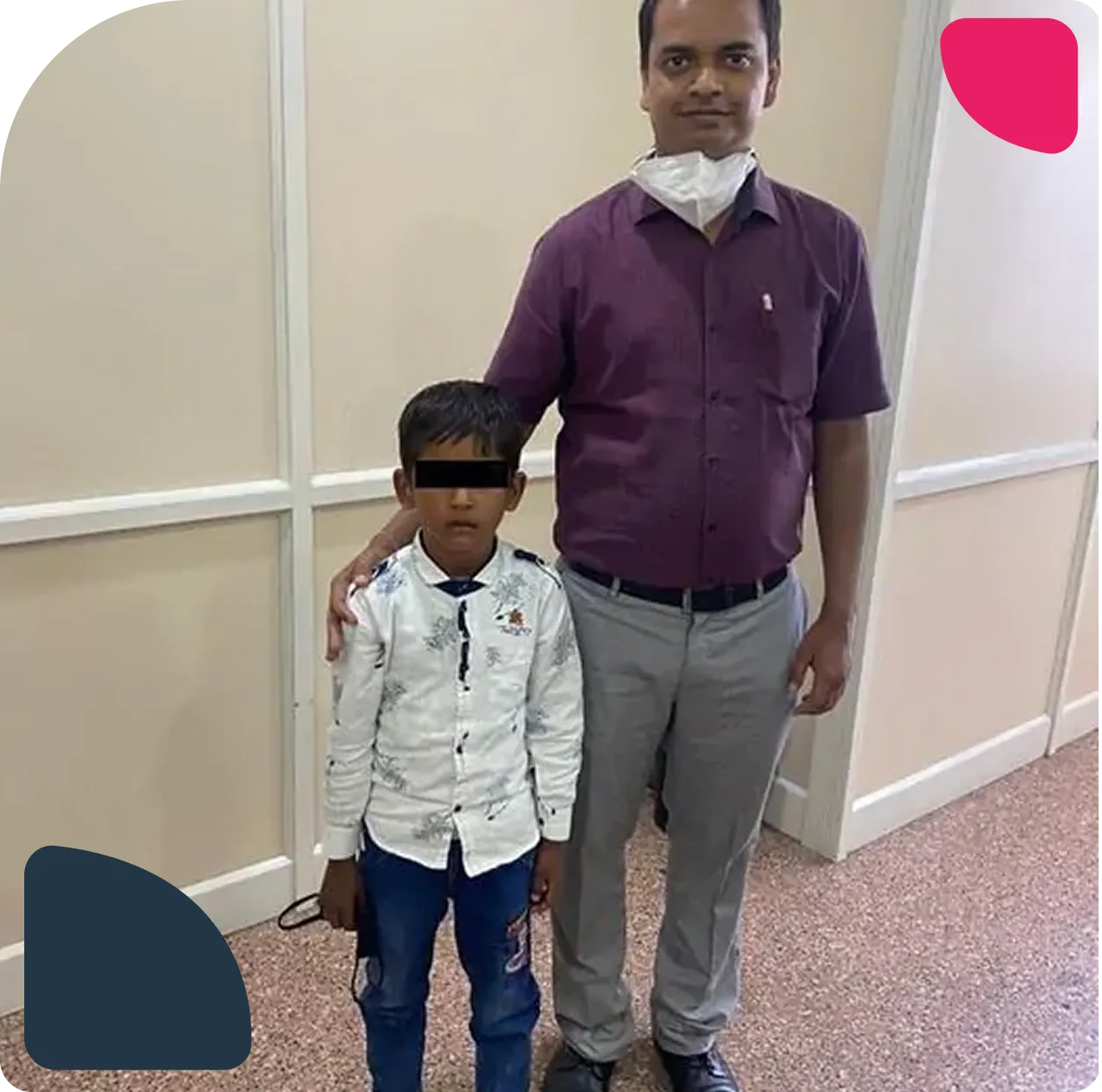
Successful Treatment by Dr. Tara Chand Gupta – Oncologist in Jaipur
This is among the happiest moments of an oncologist when you are celebrating
the birthday of your patient ( because at the time of diagnosis patient and his family members
come without any hope and in mental distress)
Cancer is the deadliest but we are committed to giving out 100% to get the best results that are
up to the international mark. Because of the patient’s faith, blessings of God, parents, and
teachers, and support of our staff we are achieving our goals.
- Age: 6 years
- Disease: Hodgkin Lymphoma
- Treated: for 6 months
- Stage: III
- Result: Complete Remission
Testimonial
What Our Patients Say on Google
Ayush Bhardwaj
Dr.Tara Chand Gupta is one of the finest oncologist of Jaipur. He currently runs this clinic to give high quality service
Deepak Sharma
Dr. Tara is the best oncologist in Jaipur. He treats my friend and help him in defeating this deadly disease….
Divya goyal
Dr. Tara Chand Gupta is one of the finest oncologist doctor in Jaipur and you treat very well…..

FAQs
Frequently Asked Questions
Dr. Tara Chand Gupta is frequently highlighted in major
Targeted therapy is basically a treatment where doctors don’t treat everything together; they first find what exactly is helping the cancer grow. It could be a gene or a protein. Once that is identified in reports, medicines are used to act on that specific part instead of affecting the whole body.
There isn’t one fixed stage for this. It is more commonly used when cancer has spread, but sometimes it is also used earlier if reports clearly show a target. So it really depends more on what is seen in testing rather than just the stage.
It can be helpful, but not in every case. It works only when the cancer has something that can be targeted. That is why doctors first check reports properly. If that target is present, then this treatment can help control the disease in a more focused way.
Both are used differently, so one is not always better than the other. Chemotherapy works in a general way, while targeted therapy is more specific. Dr. Tara Chand Gupta usually decides this after seeing reports and understanding what will actually work better for that patient.
There is no fixed time for this treatment. Some patients take it for a few months, while others may continue for longer. It mainly depends on how the cancer is responding and how the body is handling it. Doctors keep reviewing and then decide further.
It is also used in targeted therapy for breast cancer , but again, only when reports show specific markers. Treatment is not started just like that. Doctors first confirm everything and then decide if this approach will actually help.
Doctors don’t guess this; they check it through scans and blood tests. If the cancer is not growing or is reducing, that means the treatment is working. Along with that, the patient’s overall condition is also considered before deciding the next step.
There is no single success rate for everyone. It depends on the type of cancer and whether the target is actually present. In some cases, it works really well, and in others, the response is limited. Doctors usually explain this clearly after seeing reports.
In many cases, it is given in the form of tablets, so patients can take it at home. Sometimes it is given through a drip. The treatment goes on over time, and doctors keep checking how the body is responding during the process.
Yes, targeted therapy for lung cancer is quite commonly used, but only when reports show certain mutations. If those changes are present, then this treatment can work in a more direct and focused way compared to general treatments.
It usually starts with testing. Like Dr. TaraChand, check the biopsy and other reports to see if there is something that can be targeted. In targeted therapy for cancer, the plan is made only after this, so treatment is not given without reason.
Yes, options like targeted therapy for cancer in Jaipur are available. But the treatment is not the same for everyone. Doctors first check reports and then decide if this is the right option, so that it actually works for the patient.